
Entertainment
Taylor Swift and Travis Kelce: Their Full Relationship Story Explained


Few celebrity relationships have been tracked as closely as the one between Taylor Swift and Travis Kelce. What started as a missed connection at a football stadium turned into one of the most-discussed romances in recent pop culture history, mixing the worlds of music and professional football in a way few people expected.
People search for information on Taylor Swift and Travis Kelce for a lot of different reasons. Some want the basic timeline. Others want to understand how a pop star and an NFL tight end ended up together, or what their relationship looked like once wedding bells were involved. This article lays out the full story in plain terms, separating confirmed facts from speculation along the way.
Direct Answer
Taylor Swift and Travis Kelce are a married couple. Swift, a singer-songwriter, and Kelce, a Kansas City Chiefs tight end, began dating in the summer of 2023 after Kelce tried and failed to meet her during her Eras Tour stop in Kansas City. They got engaged in August 2025 and married in July 2026 at a large celebration in New York City.
Who Are Taylor Swift and Travis Kelce?
Taylor Swift is a singer-songwriter known for albums like “1989,” “Folklore,” and “The Tortured Poets Department.” She built her career on confessional songwriting, often drawing directly from her personal life, which is part of why fans pay close attention to her relationships.
Travis Kelce is a tight end for the Kansas City Chiefs and one of the most accomplished players at his position in NFL history. Off the field, he co-hosts a podcast called “New Heights” with his brother, Jason Kelce, a former NFL center. That podcast played a small but memorable role in how the Taylor Swift and Travis Kelce relationship became public.
Before they were connected romantically, the two moved in very different circles. Swift’s world revolves around global tours and album releases. Kelce’s revolves around football seasons and locker rooms. That contrast is part of what made their pairing stand out to so many observers.
How the Relationship Began
In July 2023, Kelce attended Swift’s Eras Tour show at Arrowhead Stadium in Kansas City, hoping to meet her. He didn’t get the chance and later talked about the experience on “New Heights,” saying he’d tried to give her a friendship bracelet with his phone number on it. The story spread quickly online, and it became one of the more well-known origin points of a modern celebrity relationship.
Swift later confirmed that the two started dating not long after that podcast episode aired. By the fall of 2023, Swift began showing up at Chiefs games, and Kelce started appearing at some of her tour stops. The relationship became public through their actions rather than a formal announcement, which was itself somewhat unusual for two people with this level of fame.
Key Moments in the Taylor Swift and Travis Kelce Timeline
A few moments stand out in how this relationship developed publicly:
- July 2023: Kelce attends Swift’s Eras Tour show in Kansas City and later discusses trying to meet her.
- Fall 2023: Swift starts attending Chiefs games and is seen in Kelce’s suite alongside his family.
- February 2024: Swift travels from a Tokyo tour stop to attend the Super Bowl in Las Vegas, where the Chiefs win the championship.
- June 2024: Kelce joins Swift on stage during a London tour date, a moment that became widely shared online.
- August 2025: The couple announces their engagement on Instagram, with a caption referencing Swift as “your English teacher” and Kelce as “your gym teacher.”
- July 2026: Swift and Kelce marry in New York City in a large celebration attended by friends, family, and industry figures.
This timeline shows a relationship that unfolded gradually and largely in public view, which is part of why it drew so much sustained attention.
Why the Taylor Swift and Travis Kelce Relationship Got So Much Attention
There are a few practical reasons this pairing became such a major story rather than a typical celebrity relationship.
It crossed two massive fan bases. Swift’s fanbase and NFL fandom don’t always overlap, and the relationship introduced each group to the other’s world. Ratings for Chiefs games reportedly rose when Swift attended, and NFL-related content saw a jump in interest from audiences who wouldn’t normally follow football.
Swift’s music invites this kind of scrutiny. Because Swift often writes about her personal relationships, fans regularly try to connect song lyrics to real events in her life. Tracks on her more recent albums have been widely interpreted as referencing Kelce, which kept the relationship connected to her music career rather than existing separately from it.
The contrast between their careers was genuinely interesting. A global pop star dating a professional athlete isn’t unheard of, but the specific combination of Swift’s level of fame and Kelce’s public persona, especially his podcast, gave outlets and fans a steady stream of material to talk about.
Common Misconceptions About Taylor Swift and Travis Kelce
Misconception: The relationship was a publicity stunt. This idea circulated early on, partly because the timing coincided with a ratings boost for NFL broadcasts. There’s no credible evidence supporting this claim, and both Swift and Kelce have spoken about the relationship in ways consistent with a genuine partnership, including detailed interviews about how they met and grew close.
Misconception: Swift doesn’t understand football. Swift has addressed this herself, including in lyrics acknowledging she wasn’t a football fan before meeting Kelce. Her attending games regularly and learning about the sport doesn’t mean she was faking interest; it reflects a common pattern of partners engaging with each other’s worlds.
Misconception: Every new Swift song is about Kelce. Fans often look for connections between her lyrics and her personal life, but not every song on a given album is necessarily about the same relationship or even a real one. Some tracks are interpreted this way based on timing or lyrical content, but Swift hasn’t confirmed every such theory, and treating every song as autobiographical oversimplifies her songwriting.
Real-World Example: How Fan Culture Shaped the Story
One clear example of how this relationship played out publicly involves the friendship bracelets. Swift’s Eras Tour became known for fans trading handmade bracelets inspired by her song “You’re On Your Own, Kid.” When Kelce referenced trying to give Swift a bracelet, it tied directly into an existing fan tradition, which is partly why the story spread so quickly. It wasn’t just a celebrity anecdote; it fit into a ritual that millions of concertgoers were already participating in, which made it easy for fans to feel personally connected to the story.
Another example is the Super Bowl appearance in February 2024. Swift’s decision to fly from a tour stop in Tokyo to Las Vegas became a logistics story in its own right, discussed in terms of time zones and travel schedules. It illustrated how her career and Kelce’s had started to intersect in very literal, practical ways.
Key Facts About Taylor Swift and Travis Kelce
- Taylor Swift and Travis Kelce began dating in the summer of 2023.
- Kelce plays tight end for the Kansas City Chiefs.
- The couple announced their engagement in August 2025.
- They married in New York City in July 2026.
- Kelce co-hosts the podcast “New Heights” with his brother, Jason Kelce.
- Swift has released multiple albums since the relationship began, some containing lyrics fans associate with Kelce.
- The couple has attended NFL games, awards shows, and each other’s professional events together.
Frequently Asked Questions
How did Taylor Swift and Travis Kelce meet? They didn’t meet directly at first. Kelce attended Swift’s Eras Tour show in Kansas City in July 2023 hoping to meet her, and the two began dating shortly after he discussed the experience publicly.
When did Taylor Swift and Travis Kelce start dating? Reports and Swift’s own statements indicate the relationship began in the fall of 2023, shortly after Kelce’s podcast comments about trying to meet her went public.
Are Taylor Swift and Travis Kelce married? Yes. The couple married in July 2026 in New York City after becoming engaged in August 2025.
Is Taylor Swift’s music about Travis Kelce? Some songs on her more recent albums are widely believed by fans and some media outlets to reference Kelce, based on lyrical content and timing. Swift has not confirmed every individual song is about him, so some interpretations remain speculative.
Does Taylor Swift go to Travis Kelce’s football games? Yes, she has attended many of Kelce’s games, including playoff games and a Super Bowl, since their relationship became public.
Has Travis Kelce attended Taylor Swift’s concerts? Yes. He has attended multiple Eras Tour dates, including a well-known appearance where he joined her on stage in London.
Key Takeaways
- Taylor Swift and Travis Kelce’s relationship began after Kelce tried to meet her at her Eras Tour show in Kansas City in 2023.
- The couple went public through shared appearances rather than a formal announcement.
- They got engaged in August 2025 and married in July 2026.
- The relationship drew attention partly because it merged Swift’s fan base with NFL audiences.
- Several misconceptions, including claims the relationship was staged, aren’t supported by available evidence.
Conclusion
The relationship between Taylor Swift and Travis Kelce started with a missed meeting at a football stadium and grew into a marriage that drew attention from both music and sports audiences. Their story reflects how public a modern celebrity relationship can become, shaped by fan culture, media coverage, and the couple’s own choices to share parts of their lives with the public. For anyone trying to understand how it all unfolded, the timeline above covers the confirmed milestones from their first meeting attempt to their wedding.
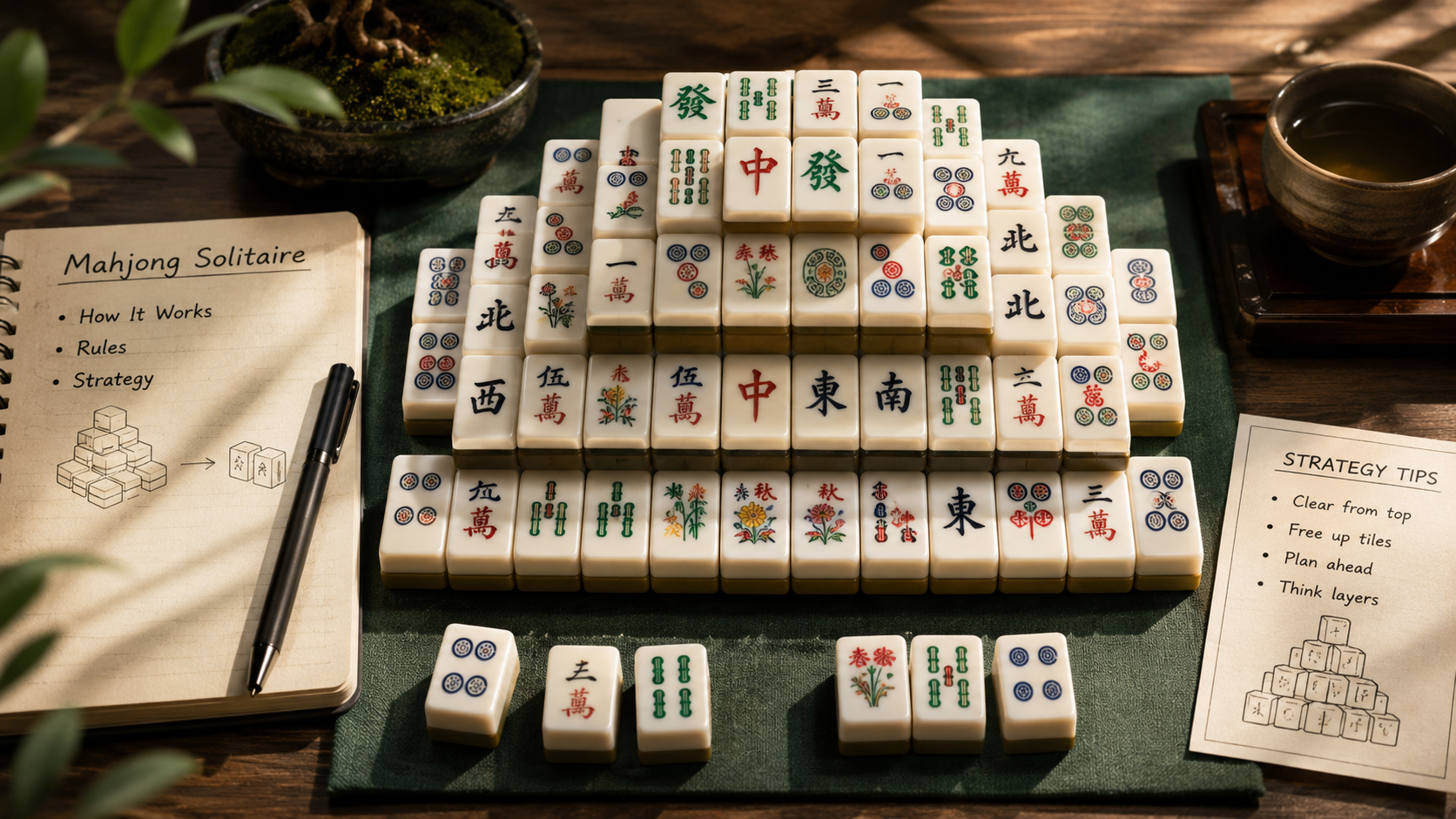
Open any app store or browse a free online game site, and you’ll likely spot a colorful grid of tiles stacked into a pyramid, turtle, or dragon shape. That’s mahjong solitaire, one of the most widely played tile-matching games in the world. People search for it when they’re bored at work, when they remember playing it on an old computer, or when they’ve just seen a friend playing it and want to understand the rules.
Despite its name, mahjong solitaire has almost nothing to do with the four-player game of mahjong that originated in China. It borrows the tiles and the artwork, but the gameplay is entirely different. This guide explains exactly what mahjong solitaire is, how it works, where it came from, and how to get better at it.
Direct Answer
Mahjong solitaire is a single-player tile-matching puzzle game where tiles are arranged in a layered layout, often shaped like a pyramid or animal figure. The goal is to remove all tiles from the board by matching identical pairs. Only tiles that are “free,” meaning not covered by another tile and open on at least one side, can be selected. The game ends when all tiles are cleared or no more matching pairs remain available.
What Is Mahjong Solitaire?
Mahjong solitaire is a puzzle game built around the 144 tiles used in traditional Chinese mahjong. Instead of forming melds or competing against other players, a single player works through a stacked arrangement of tiles, clearing the board by finding and removing matching pairs.
The tiles feature familiar mahjong imagery: bamboo sticks, circles (also called dots or wheels), Chinese characters, wind and dragon symbols, flowers, and seasons. Each tile type appears in a set number of duplicates within the 144-tile set, which is what makes pairing possible.
The game is sometimes called “mahjong solitaire,” “solitaire mahjong,” or simply “mahjong” in casual conversation, even though the traditional four-player version and the solitaire puzzle are quite different games that happen to share a tile set.
Why Mahjong Solitaire Matters
Mahjong solitaire has stayed popular for decades because it hits a specific sweet spot: it’s visually satisfying, mentally engaging, and doesn’t require memorizing complex rules like traditional mahjong does. It offers a short mental workout, similar to how a crossword or sudoku puzzle does, without needing an opponent.
It also became one of the first widely distributed computer games. Versions were bundled with early Windows software packages in the 1980s and 1990s, which introduced millions of people to tile-matching puzzles long before mobile gaming existed. That early exposure is part of why the game still feels nostalgic to many players today.
Where Mahjong Solitaire Came From
Traditional mahjong dates back to 19th-century China and involves four players competing to build sets of tiles through drawing and discarding. Mahjong solitaire is a much newer invention. It was created in the early 1980s, generally credited to Brodie Lockard, who adapted mahjong tiles into a single-player matching format after being inspired by tile games he encountered while recovering from an accident.
The game gained mass exposure through early PC titles like “Shanghai,” released in the mid-1980s, which cemented the format most players recognize today: a layered tile layout that players clear by matching open pairs. From there, dozens of variations spread across CD-ROM game collections, then websites, then mobile app stores.
How Mahjong Solitaire Works
The mechanics are simple to learn, even though solving a layout can be genuinely challenging. Here’s the core structure.
The Tile Set
A standard mahjong solitaire game uses 144 tiles, matching the traditional mahjong set. These break down into several categories:
- Suits: Bamboo, Circles, and Characters, each numbered 1 through 9, with four copies of each number
- Honors: Wind tiles (North, South, East, West) and Dragon tiles (Red, Green, White), four copies each
- Bonus tiles: Flowers and Seasons, usually one copy of each, sometimes treated as a special matching group
The Layout
Tiles are arranged in a stacked, three-dimensional pattern. The classic shape is called the “Turtle” layout, but many variations exist, including pyramids, dragons, and custom designs. Tiles sit in layers, with upper tiles resting on top of lower ones.
The Matching Rule
A tile is considered “free” only when both of these conditions are true:
- No tile is stacked directly on top of it
- At least one long side (left or right) is completely open, not blocked by a neighboring tile
Free tiles are typically highlighted or appear brighter than blocked tiles, depending on the version of the game.
Removing Tiles
To clear tiles, the player selects two free tiles that match. Matching generally means identical tiles, such as two “5 of Bamboo” tiles. Flower and Season tiles are often an exception, where any flower can match any other flower, and any season can match any other season.
Each successful match removes both tiles from the board, which can free up tiles underneath or beside them. The game is won when every tile has been removed. If no matching pairs remain among the currently free tiles, the game ends in a stalemate, even if tiles remain on the board.
Step-by-Step: How to Play a Round
- Study the layout. Look at the full board before making any moves, since early choices affect which tiles become accessible later.
- Identify free tiles. Check which tiles have no cover on top and an open long side.
- Look for matching pairs among free tiles. Only pairs where both tiles are currently free can be selected.
- Select and remove the pair. Click or tap both tiles to clear them from the board.
- Reassess the board. Removing tiles often frees up new tiles, so recheck the layout after every move.
- Repeat until the board is cleared or no moves remain.
- Use a hint or shuffle option if you get stuck, if the version you’re playing offers one.
Strategy Tips for Mahjong Solitaire
Because the game rewards planning over speed, a few habits make a noticeable difference.
Clear from the top down. Tiles higher in the stack unlock more of the board when removed, so prioritize matching pairs at the top layers early rather than saving them.
Don’t rush the easy matches. If two free tiles match but removing them won’t help access buried tiles, it can be smarter to look for a pairing that unlocks a tile blocking multiple other pieces.
Watch for isolated tiles. A tile that only has one matching partner left on the board is a priority. If that partner gets buried or becomes hard to reach, that tile can become permanently stuck, leading to a stalemate.
Track the honor and bonus tiles. Wind, Dragon, Flower, and Season tiles often have fewer available matches on the board at any given time, so keep an eye on where they sit in the layout.
Use the corners and edges strategically. Tiles positioned at the outer edges of a layout tend to become free sooner, so they’re often safer to leave for later compared to tiles buried in dense clusters.
Common Mistakes and Misconceptions
Mistake: Assuming it’s the same game as traditional mahjong. Traditional mahjong is a four-player game involving drawing, discarding, and forming specific tile combinations. Mahjong solitaire only borrows the tile artwork and is played alone.
Mistake: Thinking any two similar-looking tiles match. Tiles must be identical, aside from the flower and season exceptions. A “3 of Circles” does not match a “3 of Bamboo,” even though both show the number three.
Mistake: Believing every layout is solvable. Not all randomly generated layouts guarantee a full solution. Some digital versions specifically design “solvable” boards, while others generate the tile positions randomly, which can occasionally produce a board with no possible full clear.
Misconception: The game requires strategy knowledge from real mahjong. No understanding of traditional mahjong scoring, hands, or terminology is needed to play or enjoy mahjong solitaire.
Misconception: A stalemate means you played incorrectly. Reaching a point with no available matches doesn’t always indicate a mistake. Depending on the layout’s design, some boards can reach unsolvable states no matter how carefully earlier moves were made.
Real-World Example
Imagine a Turtle-shaped layout with five layers. At the very top sits a single Red Dragon tile, fully exposed. Two layers down, near the edges, two more Red Dragon tiles sit with open sides. Matching the top tile with one of those two clears a blocking piece and reveals tiles beneath it.
Meanwhile, in a dense center cluster, a “9 of Bamboo” tile is boxed in by tiles on both long sides. Even though its matching partner sits nearby and is technically visible, neither tile is “free” under the rules, so they can’t be matched yet. A player who understands the layout will work on clearing the tiles blocking that cluster first, rather than getting stuck waiting for a match that isn’t currently possible.
This kind of layered planning is what separates mahjong solitaire from a simple memory-matching game. It’s less about spotting matching symbols and more about sequencing which matches to make first.
Key Facts About Mahjong Solitaire
- Standard sets use 144 tiles, matching the traditional mahjong tile count
- The game is played solo, unlike traditional four-player mahjong
- Tiles must be “free,” uncovered on top and open on one long side, to be selected
- Flower and Season tiles often match any tile within their own category
- The most iconic layout is called the “Turtle”
- The game was developed in the early 1980s and popularized through 1980s PC software
- A round can end in a win, a stalemate, or an incomplete board depending on available matches
Frequently Asked Questions
What is mahjong solitaire? It’s a single-player puzzle game that uses the 144-tile mahjong set, where players clear the board by matching identical pairs of free tiles.
How is mahjong solitaire different from regular mahjong? Regular mahjong is a four-player game centered on drawing, discarding, and building tile combinations for points. Mahjong solitaire is played alone and focuses purely on matching pairs to clear a layout.
How do you win a game of mahjong solitaire? You win by removing every tile from the board through matching pairs of free tiles until none remain.
Why can’t I select two matching tiles sometimes? A tile can only be selected if it isn’t covered by another tile and has at least one long side completely open. If either condition isn’t met, the tile isn’t “free” and can’t be chosen, even if its match is visible elsewhere.
Is mahjong solitaire based on luck or skill? Both play a role. The starting layout is often randomized, which introduces an element of luck, but the order in which a player chooses to clear tiles has a real effect on whether the board can be fully solved.
Can every mahjong solitaire layout be solved? Not always. Some versions generate boards guaranteed to be solvable, while others use fully random tile placement, which can occasionally create layouts with no possible complete solution.
Do flower and season tiles work differently? Yes. In most versions, any flower tile can match any other flower tile, and any season tile can match any other season tile, rather than needing an identical match like the numbered suit tiles.
Is mahjong solitaire good for mental focus? Many players use it as a low-pressure way to practice pattern recognition and planning, similar to how people use crossword puzzles or sudoku, though it isn’t a substitute for professional cognitive training or medical advice.
Key Takeaways
- Mahjong solitaire is a single-player tile-matching puzzle, not the same game as traditional four-player mahjong
- The goal is to clear all 144 tiles by matching identical free pairs
- A tile is only playable if it’s uncovered on top and open on one long side
- Layout strategy matters more than fast reflexes
- Not every generated layout is guaranteed to be solvable
- The game traces back to the early 1980s and grew popular through early PC software bundles
Conclusion
Mahjong solitaire takes the visual richness of traditional mahjong tiles and turns them into a solo puzzle built on patience and planning rather than competition. Understanding the free-tile rule and thinking a few moves ahead is really all it takes to go from randomly clicking tiles to consistently clearing full boards. Whether played during a short break or as a longer focus exercise, it remains a simple, well-designed puzzle that has held up for more than four decades.


Taylor Swift and Travis Kelce: Their Full Relationship Story Explained

Philadelphia International Airport: The Complete Traveler’s Guide

Mahjong Solitaire: The Complete Guide to How It Works Rules and Strategy

Horoscopes Explained: What They Are How They Work and What to Know

What Is Word Wipe? The Complete Guide to How the Game Works

How to Watch Attend and Understand a Knicks Game: Complete Guide
-
 Tech4 days ago
Horoscopes Explained: What They Are How They Work and What to Know
-
 Business4 days ago
What Is Word Wipe? The Complete Guide to How the Game Works
-
 Sports4 days ago
How to Watch Attend and Understand a Knicks Game: Complete Guide
-
 Entertainment3 days ago
Mahjong Solitaire: The Complete Guide to How It Works Rules and Strategy
-
 Tech3 days ago
Philadelphia International Airport: The Complete Traveler’s Guide