Business
What Is Word Wipe? The Complete Guide to How the Game Works

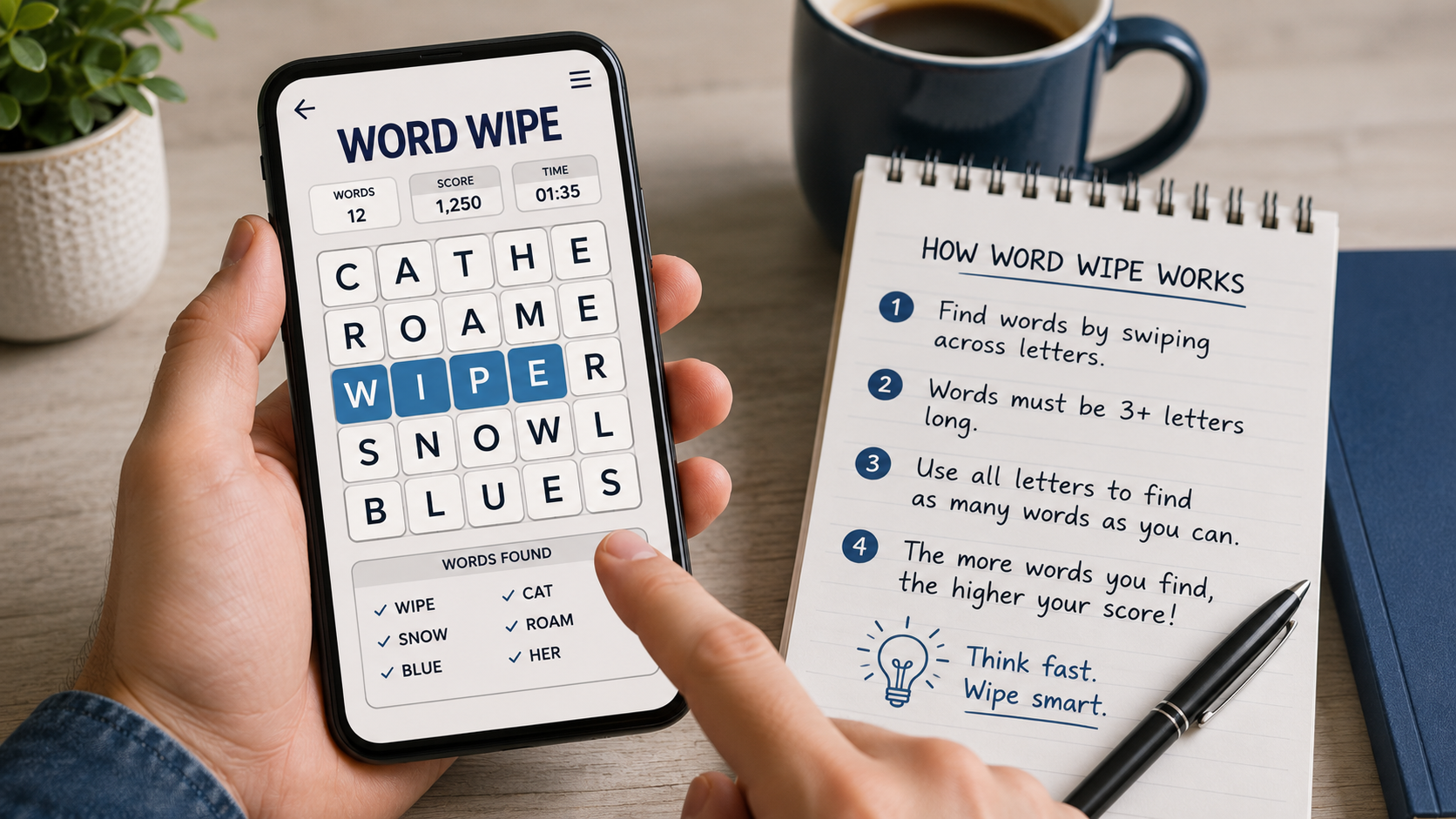
Open any casual gaming site and you’ll probably spot a grid of jumbled letters with a countdown clock ticking in the corner. That’s Word Wipe, one of the most played browser word games around, showing up on sites like the Washington Post, USA Today, and AARP. People search for it because the rules aren’t always obvious at first glance — it looks like a word search, but it plays more like a race against yourself. If you’ve ever stared at a board full of letters wondering exactly how you’re supposed to “wipe” anything, this guide walks through the mechanics, the scoring, and the small habits that separate a mediocre round from a high score.
Direct Answer: What Is Word Wipe?
Word Wipe is a timed online word puzzle where players drag across connected letters on a grid to spell valid words of three or more letters. Each completed word disappears, or “wipes,” from the board, and remaining tiles fall to fill the empty space. The goal is to clear enough rows or hit a target score before the clock runs out, with longer and rarer words earning more points.
How Word Wipe Works
Every round starts with a grid, often ten by ten, packed with random letters. Unlike a traditional word search, there’s no hidden list of answers to hunt for. Instead, players create their own words on the spot by clicking a starting letter and dragging through adjacent tiles.
Words can be formed in any direction — horizontally, vertically, diagonally, or by changing direction midway — as long as each letter in the chain touches the next one. Once a valid word is submitted, those tiles clear out, the letters above drop down, and the board reshuffles itself into new possibilities.
This constant collapsing of the grid is what makes Word Wipe feel different from a static puzzle. The board is never quite the same twice, so strategy has to adapt round by round rather than following a memorized pattern.
Basic Rules of Word Wipe
A few rules stay consistent across most versions of the game:
- Words must be at least three letters long.
- Letters must be adjacent to each other on the grid, including diagonally.
- The same tile can’t be reused twice within a single word.
- Each level has a time limit, commonly around two minutes.
- Levels typically require clearing a set number of rows or reaching a score threshold to advance.
If a word attempt isn’t valid, most versions simply reject it without a penalty, so there’s little downside to testing a guess if you’re unsure.
Why Word Wipe Matters to Players
Word Wipe sits in a sweet spot between casual entertainment and mental exercise. It’s short enough to fit into a coffee break but layered enough to reward genuine vocabulary skill. For many players, the appeal comes from three things working together: quick sessions, a visible skill ceiling, and the small dopamine hit of watching a cluttered board clear out.
It’s also become a fixture on news and lifestyle websites, which use it as a recurring feature alongside crosswords and sudoku. That context matters because it’s often the reason people encounter Word Wipe in the first place — they’re browsing a familiar site and click into the puzzle section out of curiosity.
How Scoring Works
Points scale with word length and letter value. In most versions, each letter carries its own point value similar to Scrabble, and the total is multiplied based on how many letters are in the word. That means a four-letter word using common letters can still outscore a shorter word packed with high-value tiles, but a long, uncommon word will almost always score higher than a short, easy one.
Clearing an entire level, meaning every tile on the board disappears, typically doubles the score earned in that round. Reaching bonus milestones, often around 500 points, can also unlock a bomb power-up that clears a 3-by-3 block of tiles in one move. Saving a bomb for a cluttered section of the board, rather than using it immediately, is usually the better long-term move.
Step-by-Step: How to Play Word Wipe
- Look at the full grid before making a move instead of grabbing the first word you see.
- Click or tap your starting letter.
- Drag through connected letters, in any direction, to spell a real word of three letters or more.
- Release to submit the word.
- Watch the tiles clear and new letters drop into place.
- Repeat, aiming to clear the required number of rows before time runs out.
- Use any bomb power-ups on dense clusters of unused letters rather than early in the round.
Common Mistakes and Misconceptions
Assuming it’s the same as a word search. Word Wipe has no hidden answer list. Every word is one you generate yourself, which trips up players expecting a fixed set of solutions.
Chasing only long words. Long words score well, but spending too much time hunting for a seven-letter word while the clock runs down can cost more points than it earns. A mix of quick three- and four-letter words with occasional longer finds tends to perform better.
Ignoring board structure. Some versions require clearing full rows or columns, not just any words. Players who only chase high-scoring letters without tracking which columns still have untouched tiles can run out of time before completing a level’s actual goal.
Overusing bomb power-ups early. Bombs are most valuable when they clear a genuinely stuck section of the board. Using one in the first few seconds of a level often wastes its potential.
Freezing up over uncertain words. Since incorrect guesses usually aren’t penalized, hesitating over whether a word is valid costs more time than simply trying it.
Real-World Example
Picture a ten-by-ten grid with a loose cluster of letters: E, R, U, C, T, S sitting near each other in one corner. A player in a hurry might grab “CUT” for a quick three-letter clear. A more patient player scanning the same cluster might notice “TRUCE” is buildable, worth meaningfully more points for the same amount of screen space. Neither choice is wrong, but understanding the trade-off between speed and word length is the core skill the game is built around.
Key Facts About Word Wipe
- Words must be a minimum of three letters.
- Letters can connect in any direction, including diagonal and reversed order.
- The game is timed, usually around two minutes per level.
- Longer words and rarer letters generally earn more points.
- Clearing a full board typically doubles the round’s score.
- Bomb power-ups clear a block of tiles at once and are earned through bonus milestones.
- The game is widely available for free on news, puzzle, and casual gaming websites.
Frequently Asked Questions
What is Word Wipe? It’s a timed word puzzle where players connect adjacent letters on a grid to spell words, which then clear from the board.
How do you play Word Wipe? Click a starting letter, drag through connected tiles to spell a valid word of three or more letters, then release to submit it and clear those tiles.
Why is Word Wipe popular? It combines a short play session with a genuine vocabulary challenge, which makes it a common feature on news and puzzle websites.
Is Word Wipe free to play? Most versions found on gaming and news sites are free, often supported by ads rather than a purchase or subscription.
Is Word Wipe difficult to learn? The core rule set is simple, but scoring well takes practice recognizing word patterns quickly under time pressure.
What are alternatives to Word Wipe? Players who enjoy it often also try word search, word scramble, or letter-boggle style games that use similar letter-connecting mechanics.
What should new players know before starting? There’s no penalty for an invalid guess in most versions, so it’s worth attempting a word even when unsure, and saving power-ups for genuinely stuck sections of the board tends to pay off more than using them right away.
Key Takeaways
- Word Wipe is a timed grid puzzle, not a fixed-answer word search.
- Words need at least three connected letters and can run in any direction.
- Longer, less common words earn more points, but speed still matters against the clock.
- Clearing a full board usually doubles your score for that level.
- Bomb power-ups are most useful when saved for cluttered parts of the grid.
- Guessing carries little risk, since invalid words typically aren’t penalized.
Conclusion
Word Wipe rewards a mix of vocabulary and quick decision-making rather than pure speed or pure skill alone. Once the basic mechanics click — connecting letters in any direction, racing the clock, and balancing short words against longer ones — the game becomes less about luck and more about reading the board efficiently. Whether it’s a two-minute break or a longer session chasing a high score, understanding these mechanics is what turns a chaotic grid of letters into a game with real strategy behind it.



Taylor Swift and Travis Kelce: Their Full Relationship Story Explained

Philadelphia International Airport: The Complete Traveler’s Guide

Mahjong Solitaire: The Complete Guide to How It Works Rules and Strategy

Horoscopes Explained: What They Are How They Work and What to Know

What Is Word Wipe? The Complete Guide to How the Game Works

How to Watch Attend and Understand a Knicks Game: Complete Guide
-
 Tech4 days ago
Horoscopes Explained: What They Are How They Work and What to Know
-
 Sports4 days ago
How to Watch Attend and Understand a Knicks Game: Complete Guide
-
 Entertainment3 days ago
Mahjong Solitaire: The Complete Guide to How It Works Rules and Strategy
-
 Entertainment3 days ago
Taylor Swift and Travis Kelce: Their Full Relationship Story Explained
-
 Tech3 days ago
Philadelphia International Airport: The Complete Traveler’s Guide